



White Tie: A Guide to the Most Formal Dress Code (Version 2)
White tie is the most formal evening dress code. An invitation may say "white tie" or "evening dress", and both mean the same thing: a black tailcoat and matching trousers, a white waistcoat, a stiff-fronted shirt with a wing collar, and a white bow tie.
It is worn far less often than black tie, so most men come to it with less practice, and its rules are stricter. Black tie allows some choice of lapel, colour and cloth, as our guide to black tie [link] explains. White tie allows very little, and the pieces only look right when they are cut to work together.
When White Tie Is Worn
White tie is now kept for a small number of occasions. State banquets given by the King are the best known. The dress code is also kept at some livery company dinners in the City of London, at certain balls, and at ceremonial occasions and some university balls and college dinners. It is occasionally asked for at a formal evening wedding.
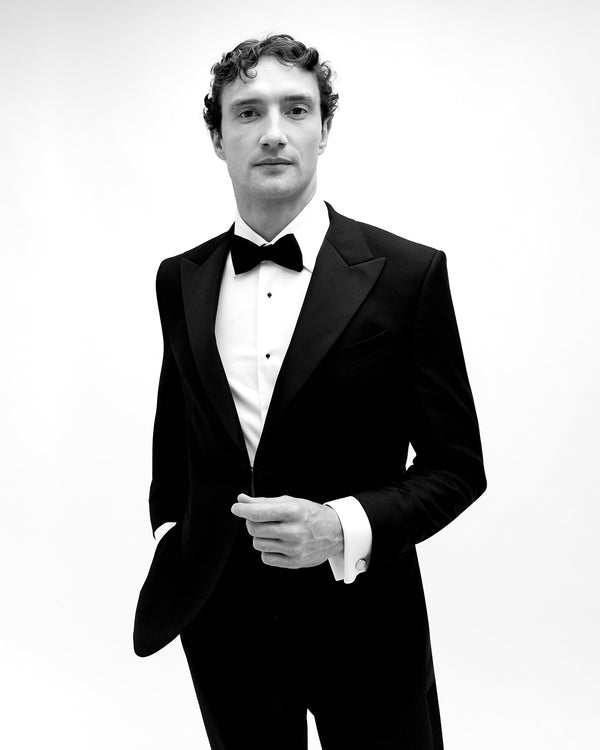
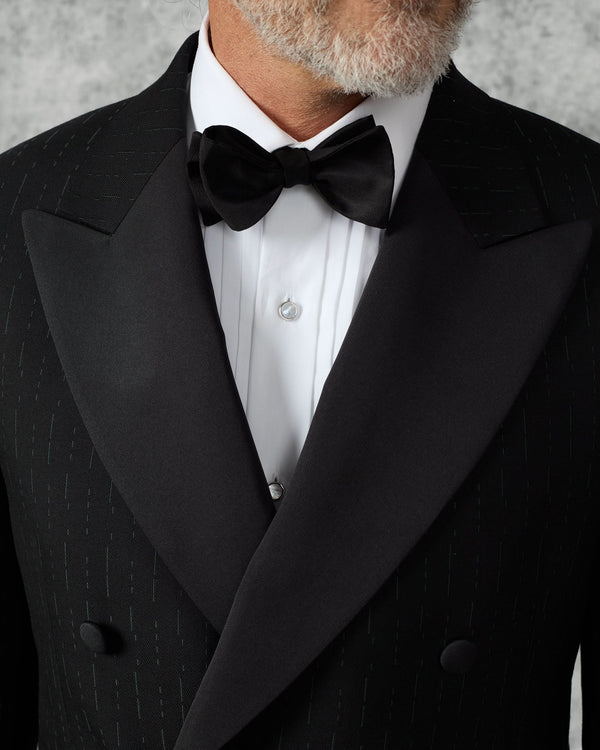
Where black tie means a dinner jacket and a black bow tie, white tie replaces the jacket with a tailcoat and makes the waistcoat and bow tie white. A cummerbund is never worn with it, and there is no place for a velvet jacket, a coloured bow tie or a shawl lapel. The shirt is stiffer, the collar is always a wing collar, and the trousers carry two lines of braid rather than one.
Serving officers will often see an invitation that reads "white tie or mess dress". Mess dress is the military equivalent of evening dress, and the two share a long history in our workrooms: Hawkes was founded as an army tailor in 1771 and Gieves as a naval tailor in 1785, as our military history [link] sets out. Our military tailors at No. 1 Savile Row still make Royal Navy mess dress today.

The Tailcoat and Trousers (use image of full suit)
The Evening Tailcoat
The evening tailcoat is the defining garment of White Tie and perhaps the most enduring expression of traditional English formal dress. Its proportions have changed remarkably little over the generations, a testament to the enduring standards of British tailoring. The distinctive cut is short at the front, finishing at the natural waist, with the coat cut away to reveal the white waistcoat. Two separate tails extend towards the back of the knee, creating its unmistakable silhouette.
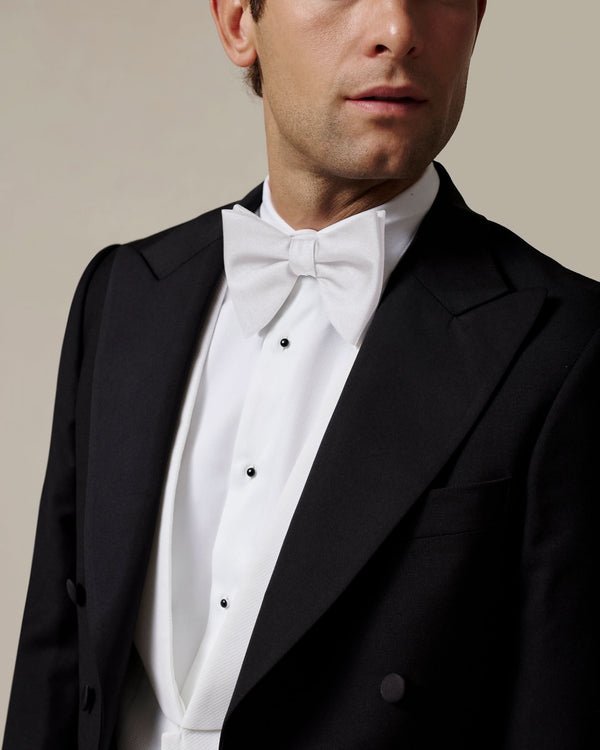
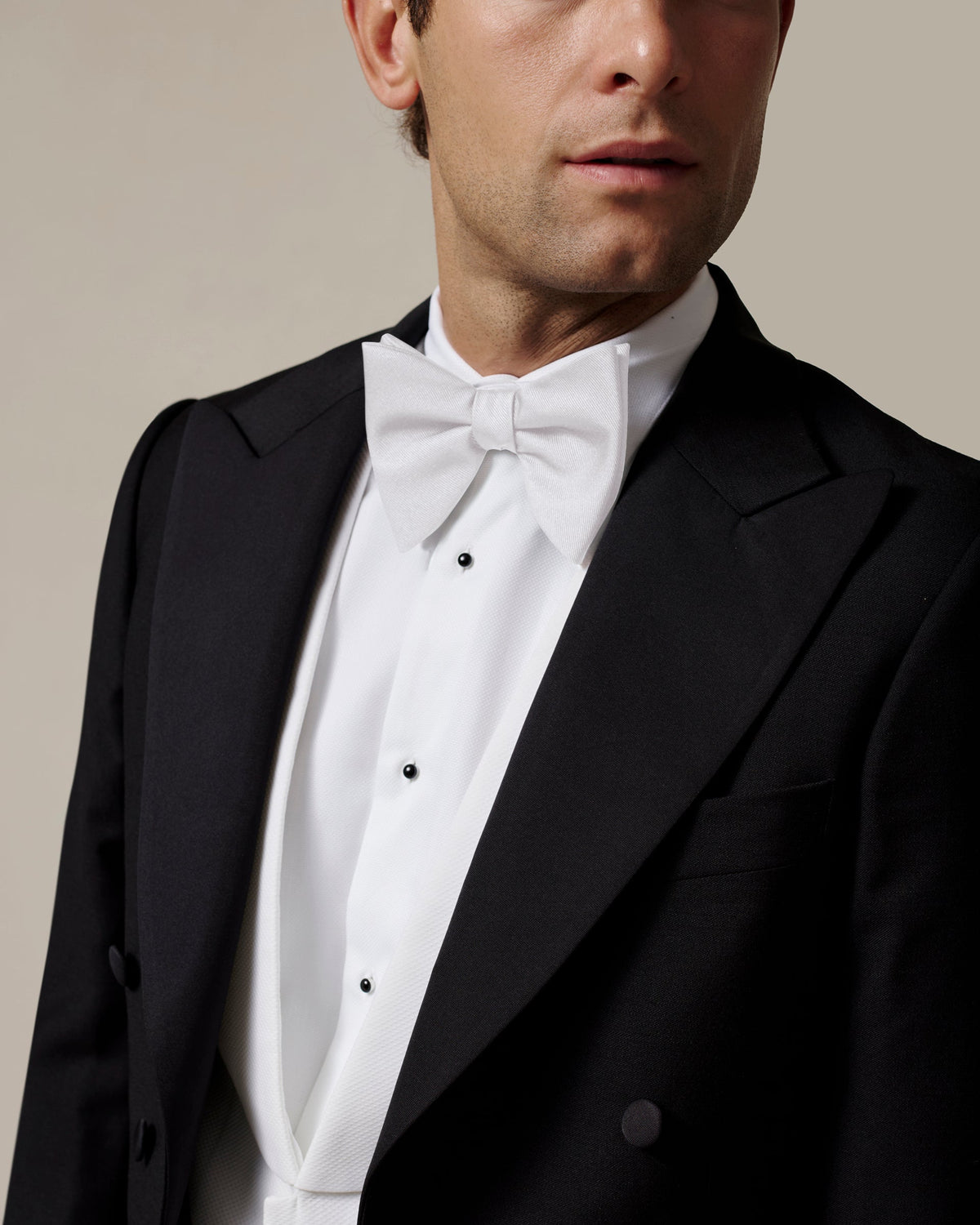
Traditionally made in black barathea or fine wool and mohair, midnight navy is also appropriate. Our Gieves & Hawkes tailcoat is crafted from British-milled wool and mohair barathea, reflecting the cloth and craftsmanship associated with Savile Row. The obligatory peaked lapels are faced in silk, either grosgrain or satin, while the front features two rows of three buttons.
The back is equally distinctive, with two buttons at the waist and a carefully tailored pleated detail leading into the two tails. The sleeves are cut relatively narrow and finished with four closely set buttons, allowing a glimpse of the formal shirt's cuff.
Unlike a lounge coat or dinner jacket, the tailcoat is always worn open. Its purpose is to frame the white shirt and waistcoat, with the front points sitting just below the natural waist to preserve the clean line of the ensemble.
The Trousers
White Tie trousers are made from the same cloth as the tailcoat, with two narrow lines of silk braid running down the outside of each leg. They are traditionally high-waisted, with a clean front, and are worn without turn-ups or belt loops. Braces support the trousers and help maintain their position.
They should sit at the natural waist rather than on the hips. This is important not only for the line of the trousers, but also because the waistband should be concealed by the waistcoat. The higher rise allows the waistcoat to sit at the correct height and creates the proportions intended for the ensemble.
The leg should fall cleanly towards the shoe, with a slight break at the front and no excess fabric gathering at the hem. The two lines of braid should remain straight and uninterrupted, following the outside seam of each leg.

The Waistcoat, Shirt, Shoes and Accessories
The waistcoat is traditionally made from white marcella, a cotton piqué recognized by its finely textured surface. It is cut low at the front to reveal the shirt and may be single or double-breasted, often with a shawl collar. Its simplicity is deliberate: the white cloth provides a clear contrast against the dark tailcoat.
Its length and fit are particularly important. The waistcoat should cover the trouser waistband and finish neatly beneath the front points of the tailcoat, without extending beyond them. It should sit close to the body while allowing comfortable movement, maintaining a clean line beneath the coat.
The shirt is white, traditionally with a stiff marcella front and a wing collar. The collar may be detachable and is secured with collar studs, while the shirt front is fastened with dress studs rather than ordinary buttons. Double cuffs, finished with cufflinks, complete the formal arrangement. A small amount of shirt cuff should be visible beneath the tailcoat sleeve.
The bow tie is white marcella to match the waistcoat and is traditionally tied by hand. Its proportions should complement the collar, sitting neatly beneath the wings without being concealed by them. Together, the shirt, waistcoat and bow tie establish the distinctive formality of White Tie.
Footwear should be black and suitably formal. Patent leather lace-up shoes and traditional evening pumps, often finished with a grosgrain bow, are both appropriate. Black silk socks [link] are traditionally worn, long enough to ensure that no leg is visible when seated.
Accessories are kept restrained. Dress studs [link] and cufflinks [link] may be finished in mother of pearl, onyx, gold or silver, while a pocket watch is the traditional choice in place of a wristwatch. Each detail should complement the ensemble without drawing attention away from its overall simplicity.
White gloves may still be worn for certain balls and formal occasions, although they are no longer universally expected. For travelling to and from an event, a dark overcoat long enough to cover the tails, accompanied by a white silk scarf, is appropriate.

A Heritage of Formal Tailoring (prince will image)
White tie represents one of the most considered forms of traditional British tailoring. Its conventions leave little room for variation, placing particular importance on the quality of the cloth, the precision of the cut and the relationship between each individual garment.
Gieves & Hawkes has a longstanding association with formal and ceremonial dress, shaped by its history of outfitting military and distinguished clients. This heritage is reflected in the house's approach to British tailoring, with particular attention to proportion, construction and finish.
An image of Prince William wearing White Tie made by Gieves & Hawkes offers a notable example of this heritage. It also illustrates the enduring relevance of the house's formal tailoring and its place within the tradition of British evening dress.
Made to Measure and Bespoke
The precision required of White Tie makes it particularly suited to considered tailoring. At Gieves & Hawkes, Made to Measure and Bespoke services are available across all our stores, offering two approaches to creating formal evening dress.
Explore our Eveningwear collection or discover our Made to Measure [link] and Bespoke services [link].