A Gentleman's Guide to Black Tie
Few phrases in the English language carry as much quiet authority as two words on an invitation: black tie. It is a dress code that has endured for well over a century, and for good reason. When observed correctly, it lends every man in the room the same unhurried elegance, regardless of age or stature. Yet the rules, while fewer than many suppose, do matter. Here is what a gentleman should know.

The Dinner Suit: Anatomy of the Standard
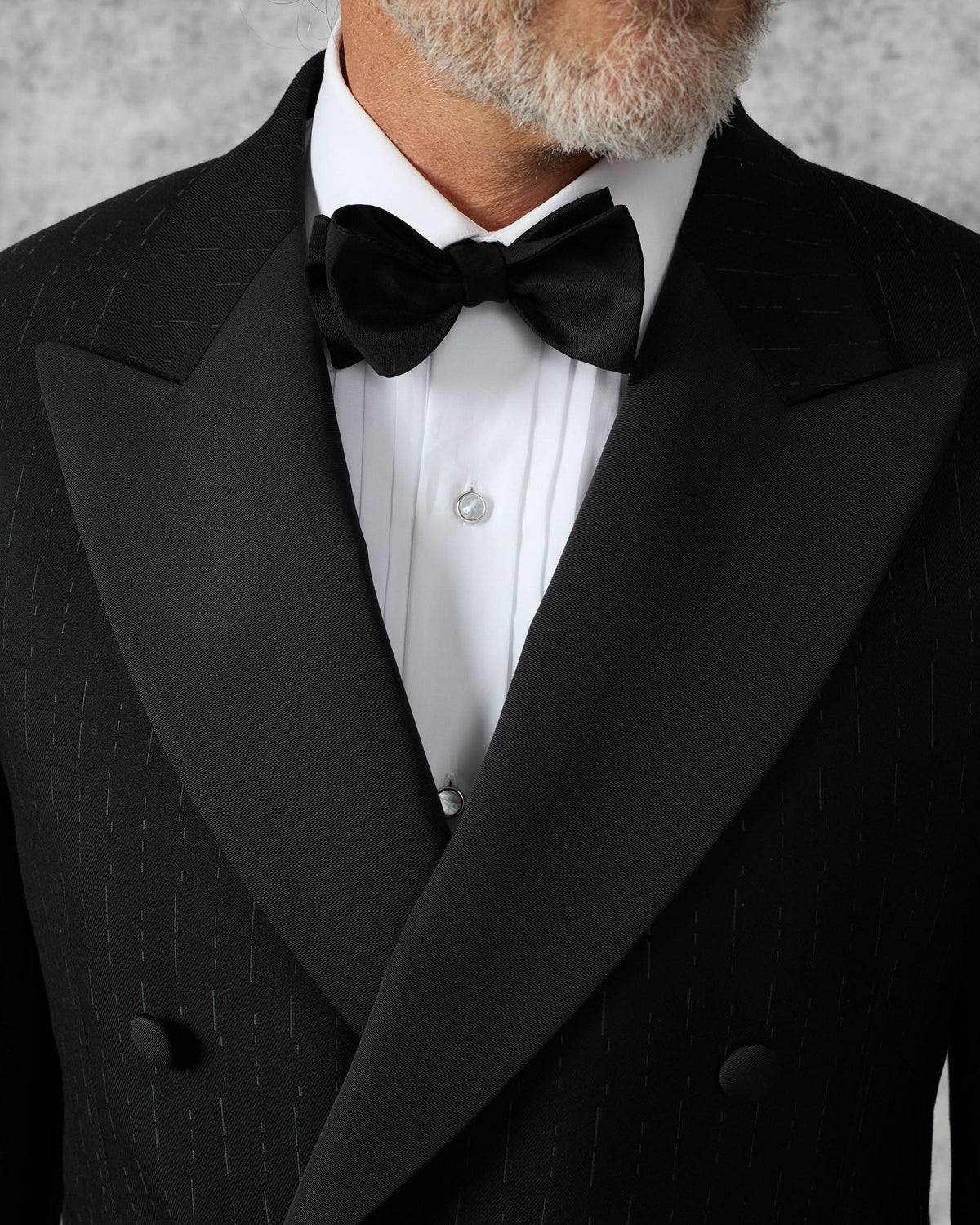
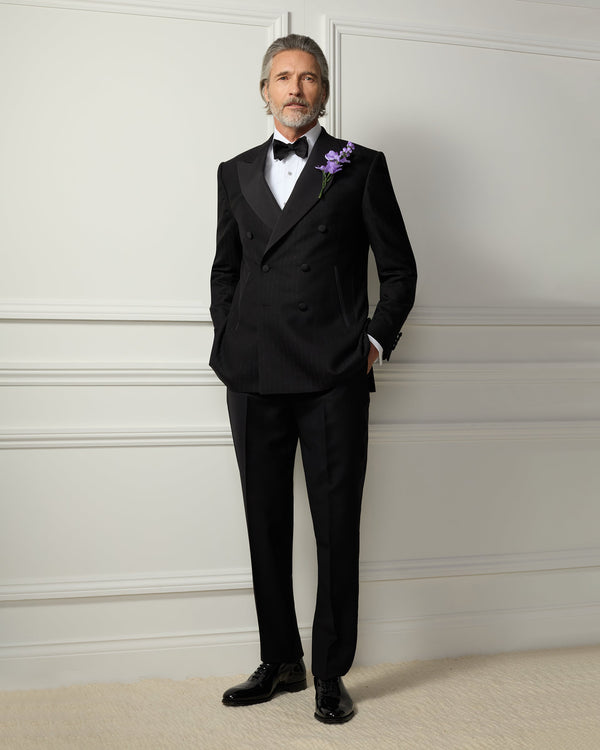
The foundation of black tie is the dinner suit. In its most traditional form, it consists of a single-breasted jacket in black or midnight navy with silk-faced peak or shawl lapels, and matching trousers with a single braid down the outside seam. Peak lapels are the more formal choice and tend to suit a wider range of builds. Shawl lapels offer a softer, more rounded line that some men prefer for its understated quality. Both are correct.
Our house dinner suits are cut in barathea or a fine jacquard weave, with grosgrain or satin facings. The jacket is single-button, the pockets jetted, the silhouette clean. It is the product of a tradition that has dressed officers, diplomats and statesmen for over 250 years.
A word on colour. Under artificial light, black cloth can appear flat and characterless. Midnight navy, by contrast, reads as a richer, deeper shade that catches the light and gives the cloth genuine life. It is a choice favoured by those in the know since the Duke of Windsor popularised it in the 1930s, and it remains the connoisseur s preference.

The Shirt, the Bow Tie and the Details
A white dress shirt with a marcella or pleated front is the only appropriate choice. The collar should be a wing tip or a wide spread, and turnback cuffs are traditional, allowing for cufflinks that should be simple and discreet. Silver or mother-of-pearl is ideal.
The bow tie must be black silk, and it must be self-tied. A pre-tied bow announces itself from across the room, and not favourably. If you cannot yet tie one, learn. It takes twenty minutes of practice and serves you for a lifetime.
Black patent Oxfords or pumps are the traditional standard, though well-polished plain-toe calfskin Oxfords are equally acceptable and, for many men, rather more comfortable. Socks should be black, in a fine gauge. A white linen pocket square, folded flat, is all that is needed. Accessories should be kept to a minimum: a dress watch with a plain face and a leather strap, nothing more. Restraint is the defining principle of evening dress.

The Errors to Avoid
The most frequent mistake is treating black tie as an opportunity for self-expression through colour, pattern or novelty. It is not. Its power lies precisely in its uniformity. A long tie has no place with a dinner suit; it is a bow tie or nothing. Trousers are held by side adjusters or braces, never a belt. And brown shoes, however fine, belong to another occasion entirely.
Equally, resist the temptation to over-think it. Black tie is designed to simplify, not complicate. Once you have the right suit and the right shirt, the rest falls into place with very little effort. That is rather the point. The man who dresses correctly for a wedding or a formal dinner should be thinking about the evening ahead, not about what he is wearing.

A well-made dinner suit is, paradoxically, one of the most economical purchases in a man s wardrobe. Fashion does not touch it. The cut remains constant across decades. A dinner suit commissioned today at Savile Row will be as correct in twenty years as it is this evening.
Whether through our made to measure or bespoke services, we can ensure the dinner suit fits as it should and wears as it must. Visit us at any of our stores to begin.