



White Tie: A Guide to the Most Formal Dress Code
White tie is the most formal evening dress code. An invitation may say "white tie" or "evening dress", and both mean the same thing: a black tailcoat and matching trousers, a white waistcoat, a stiff-fronted shirt with a wing collar, and a white bow tie.
It is worn far less often than black tie, so most men come to it with less practice, and its rules are stricter. Black tie allows some choice of lapel, colour and cloth, as our guide to black tie explains. White tie allows very little, and the pieces only look right when they are cut to work together.
When White Tie Is Worn
White tie is now kept for a small number of occasions. State banquets given by the King are the best known. The dress code is also kept at some livery company dinners in the City of London, at certain balls, and at ceremonial occasions and some university balls and college dinners. It is occasionally asked for at a formal evening wedding.
Where black tie means a dinner jacket and a black bow tie, white tie replaces the jacket with a tailcoat and makes the waistcoat and bow tie white. A cummerbund is never worn with it, and there is no place for a velvet jacket, a coloured bow tie or a shawl lapel. The shirt is stiffer, the collar is always a wing collar, and the trousers carry two lines of braid rather than one.
Serving officers will often see an invitation that reads "white tie or mess dress". Mess dress is the military equivalent of evening dress, and the two share a long history in our workrooms: Hawkes was founded as an army tailor in 1771 and Gieves as a naval tailor in 1785, as our military history sets out. Our military tailors at No. 1 Savile Row still make Royal Navy mess dress today.

The Tailcoat and Trousers
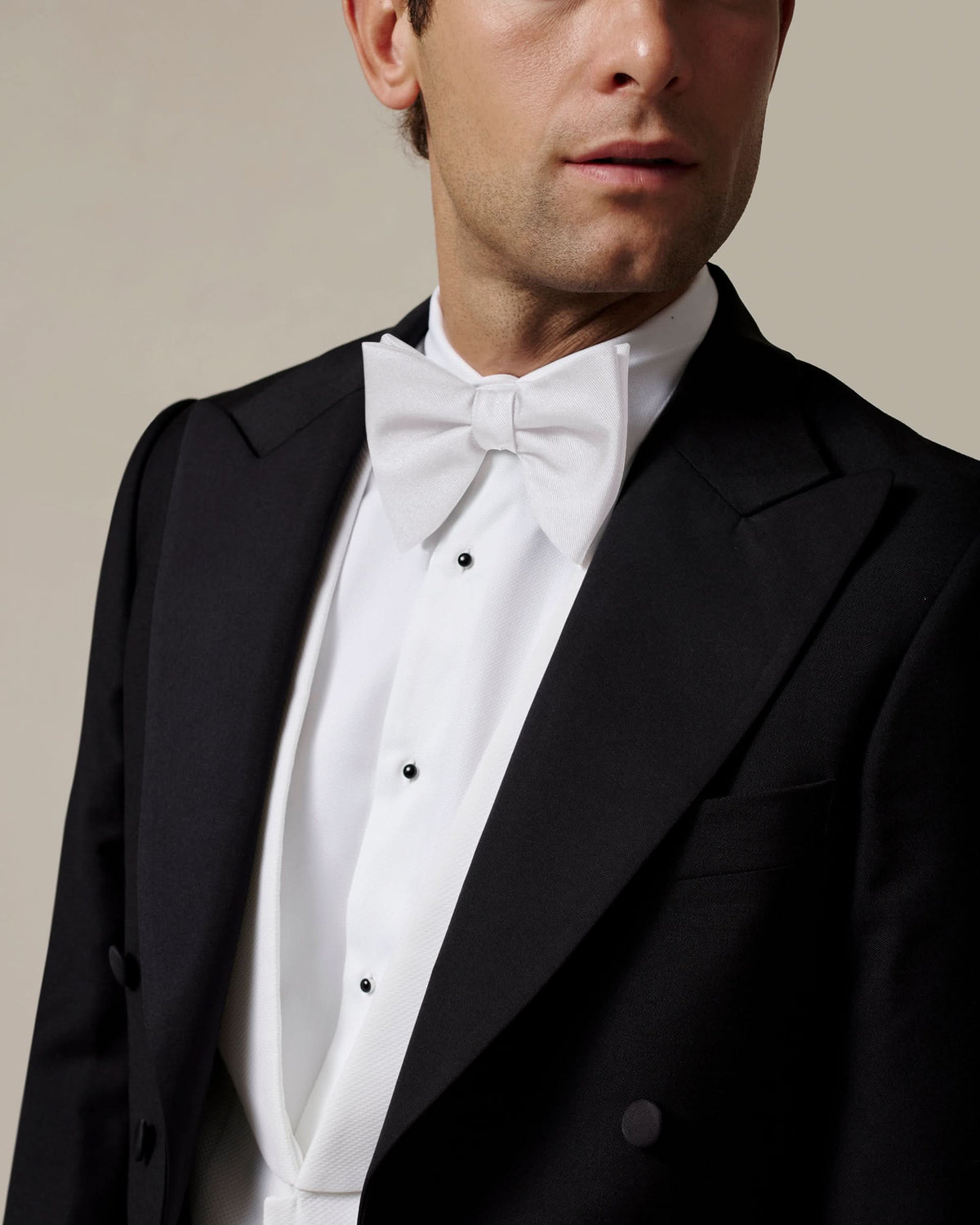
The evening tailcoat is cut short at the front, finishing at the natural waist, with two tails behind that fall to about the back of the knee. It is made in black barathea or a fine wool and mohair, and midnight navy is also correct. The lapels are peaked and faced in silk, either grosgrain or satin, and the front carries two rows of buttons, usually three on each side.
The tailcoat is always worn open. The buttons are there for the line of the coat, and the fronts are cut to sit apart so that the coat frames the white waistcoat and shirt rather than covering them. Seen from the side, the edge of the coat should run cleanly from the front points down to the tails.
The trousers are made from the same cloth as the coat, with two narrow lines of braid down the outside of each leg. They have no turn-ups and no belt loops. White tie trousers are cut with a high rise and held at the waist by braces or side adjusters, so the cloth falls straight to the shoe.

The Waistcoat, Shirt and Bow Tie
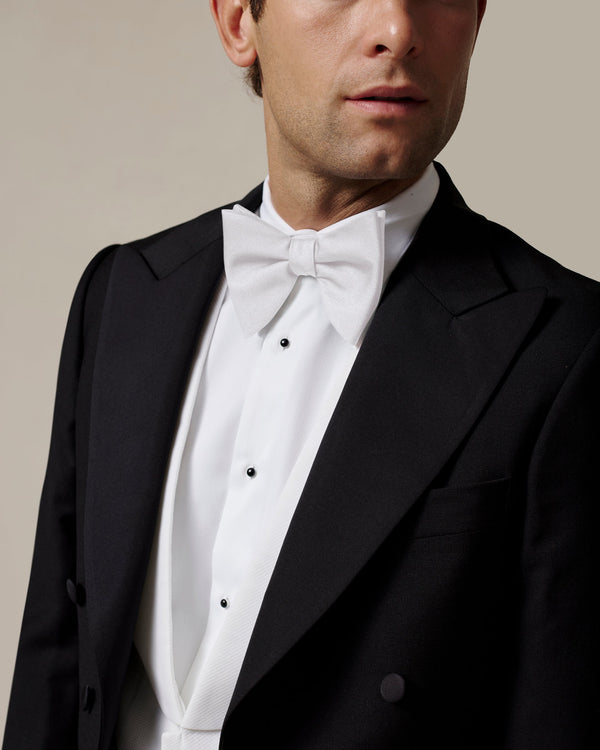
The waistcoat is white marcella, a cotton piqué with a fine raised weave, and it is cut low at the front to show the shirt. It may be single or double-breasted, and many have a shawl collar. Its length matters more than any other detail: the waistcoat must not show below the front of the tailcoat. It should finish at or just above the points of the coat, so that from the front a white waistcoat sits inside a black coat with nothing hanging beneath it.
The shirt is white with a stiff front, usually in marcella, and a wing collar. The traditional collar is detachable and starched, held to the shirt with collar studs. The front is closed with dress studs rather than buttons, and the cuffs are fastened with cufflinks. A stiff front stays flat under the low opening of the waistcoat, where a soft pleated shirt of the kind often worn with black tie tends to bunch.
The bow tie is white marcella to match the waistcoat, and it should be tied by hand. The wings of the collar sit behind the bow, not in front of it. The bow should be in proportion to the collar and the face, and one that is much wider than the collar points looks out of scale.

Shoes, Accessories and Decorations
Shoes are black patent leather, either plain lace-up Oxfords or court shoes, the slip-on evening pump finished with a flat grosgrain bow. Socks are black silk and long enough that no leg shows when you sit down.
Studs and cufflinks should match each other, in mother of pearl, onyx or plain gold or silver. A wristwatch is traditionally left off with white tie, and a pocket watch is the older alternative. White gloves were once worn for dancing and in receiving lines. They are now rarely expected, though some balls still ask for them. For the journey, a dark overcoat long enough to cover the tails and a white silk scarf go over the tailcoat.
Decorations are worn only when the invitation asks for them, usually with the words "white tie, decorations" or "evening dress, decorations" at a state or royal occasion. Miniature medals are worn on a bar on the left lapel of the tailcoat. Holders of senior orders may also wear one neck badge at the collar and breast stars on the left side of the coat, and Grand Cross holders may wear the riband and badge. Our military tailors mount full-size and miniature medals by hand.

Fit, and Hiring or Having One Made
White tie is the hardest dress code to fit off the peg, because the coat, waistcoat and trousers depend on one another. The trouser rise has to be high enough for the waistcoat to cover the waistband, and the waistcoat has to stop above the points of the coat. If the trousers sit too low, the waistcoat has to be longer to cover them and then shows beneath the coat. If the waistcoat is too short, a band of shirt appears at the waist. All three should be fitted together, with the shirt you will wear on the night.
The coat fronts should finish at the natural waist and the tails at about the back of the knee. The sleeves should show around a centimetre of shirt cuff with your arms at your sides. A starched wing collar has no give, so the shirt should be sized to close comfortably at the neck.
Hiring is practical for a single occasion. Hire garments are made to fit a wide range of figures, though, and it is usually the relationship between waistcoat and trousers that goes wrong. If you expect to wear white tie more than a few times, at livery dinners, regular balls or ceremonial occasions, owning a tailcoat makes more sense, and the fit only has to be settled once.
Our eveningwear collection covers white tie as well as black tie. A tailcoat can also be made to your measurements through our bespoke service at No. 1 Savile Row, and our made to measure team can advise on eveningwear in any of our stores.